
Midrand
Midrand starter bay
A team in Midrand set up their first DTF printing bay with our Starter Bay Bundle and Cure Check Kit, getting production-ready in the first week.

Starting from scratch, the Midrand shop needed to make sure their first DTF jobs ran smoothly on all the standard fabrics. By day five, their team had a working print to powder to press flow, with the right checks to keep it that way.
Launching DTF in a new workspace
The Midrand shop was converting a spare storeroom into a dedicated DTF work bay, aiming to offer print-on-demand for schools, clubs and local events. They needed a practical, repeatable process for their home and workwear blanks, with no time for do-overs once the orders came in. The team wanted to get comfortable with press-side handling, curing and checking results before taking on paid jobs.
Their setup space had a single print table, a mid-size press and basic extraction. The main challenge was getting reliable transfers on both cotton and polyester, even as the Highveld air swung between dry mornings and stormy afternoons.
Getting hands-on with the Starter Bay Bundle
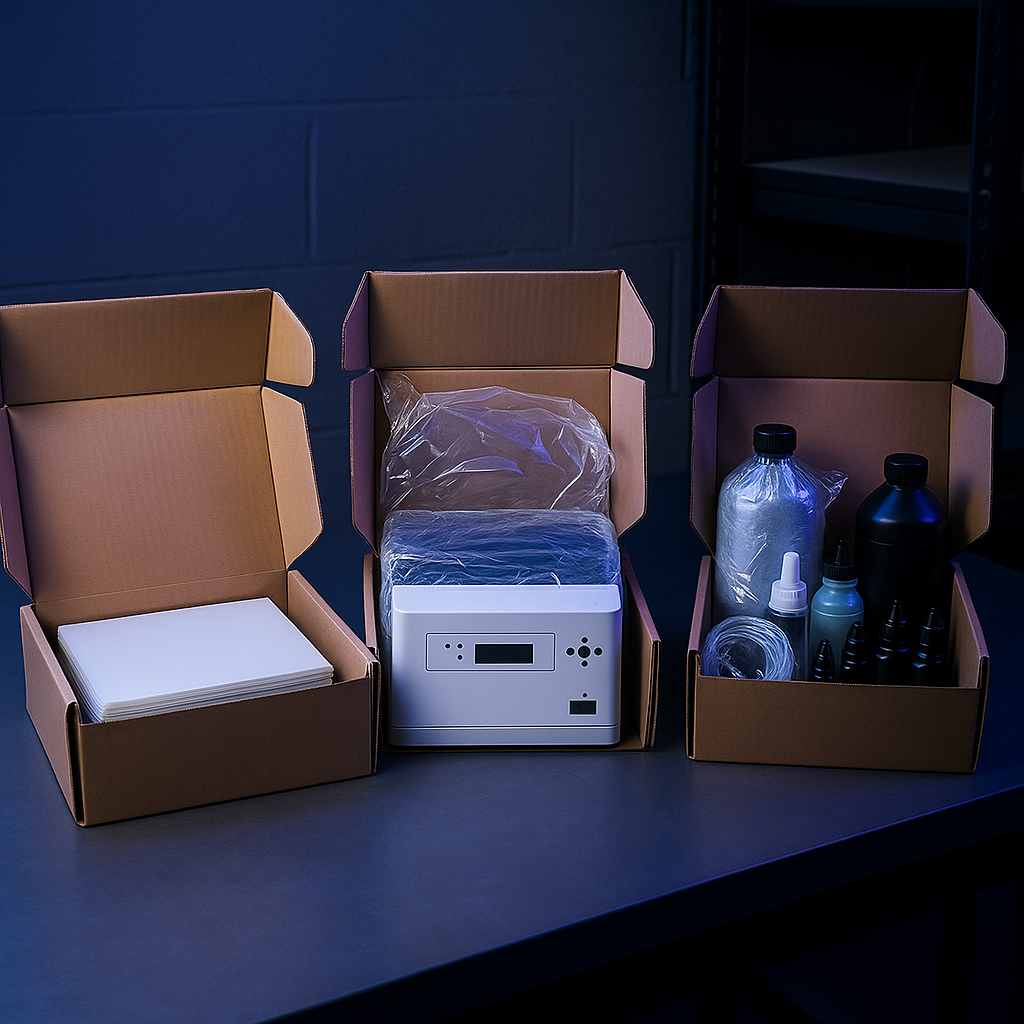
We supplied the Starter Bay Bundle, CMYK plus white DTF ink set, PET film in A3 cold-peel sheets, fine-grade TPU adhesive powder, Teflon sheet, lint-free wipes, and a Cure Check Kit. Before any prints, we walked the team through white ink agitation: rolling and inverting the bottles, running an automated white circulation on the printer, and confirming a clean nozzle check before every print shift.
Press settings started at 150 to 155 degrees C for 12 seconds on cotton, 135 degrees C for 13 seconds on polyester, both at medium-firm pressure. The team trialled pre-pressing garments for 3 seconds, tested cold peel at different cooling times, and used the Cure Check Kit to confirm powder cure was glossy and not tacky. Key routines included storing film flat in resealed packs, wearing gloves and a mask for powdering, and keeping a hygrometer on the wall to watch humidity.
The first few print runs made it clear how much static could build up on dry days, so we suggested running a humidifier and lightly wiping the table. They quickly adopted a habit of keeping the print room above 45 percent relative humidity, and double-checking the press temperature with an infrared thermometer.
- Agitated white ink every shift
- Used Cure Check Kit on every batch
- Logged press temps and times for each fabric
- Stored film flat and airtight
- Kept hygiene and PPE routine for powder
Sticking with a working process and future tweaks
After the first week, the Midrand team made daily white ink agitation and nozzle checks part of opening routines. They pressed a test square on every new batch, adjusted for weather, and used the Cure Check Kit to double-check powder cure whenever they changed anything in the process.
Looking back, we would add black adhesive powder for polyester in future, to help block dye migration on dark sport shirts. We’d also recommend a small UPS for the printer, just to avoid nozzle surprises after a power cut. The team has kept their workflow simple and consistent, so they’re ready to scale up for the next school term rush.

Customer reviews
What our DTF Ink customers say
Verified Google reviews
Talk to DTF Ink
Tell us about your printer, film, powder and press settings and our team will help you get repeatable transfers. Meadowdale lab in Germiston, plus seven studios.